
Helping clinicians manage one of immunotherapy’s most serious risks
Defining cytokine release syndrome at a turning point for cancer care
Revolutionary immunotherapy tools began transforming cancer treatment in the mid-to-late 2010s, promising more precise and durable therapies.
Treatments including checkpoint inhibitors, monoclonal antibodies, cytokines, and vaccines soon began to change expectations for patients with diseases such as acute lymphoblastic leukaemia and lymphoma. But clinicians soon recognised a serious risk: the same therapies producing dramatic remissions could also trigger a severe inflammatory reaction known as cytokine release syndrome (CRS).
CRS could escalate rapidly – with life-threatening consequences.
A major review of the syndrome, published in 2018 in the Journal for ImmunoTherapy of Cancer, clarified that risk at a critical moment, as treatments such as CAR T cell therapy and bispecific antibodies transitioned from clinical trials to routine practice.
At the time, clinical experience with CRS was evolving rapidly but remained limited. Much of the available evidence came from highly selected trial populations rather than everyday practice. As lead author Dr Alexander Shimabukuro-Vornhagen explains: “Most available data came from highly selected clinical trial populations, and there was limited guidance for managing CRS in broader, real-world settings.”
Their work brought together what clinicians urgently needed to know: how CRS develops and presents, how to distinguish it from similar conditions, and how to manage it safely. The review translated a fast-evolving evidence base into a practical clinical framework, helping teams address toxic effects that were becoming a barrier to the safe use of immunotherapy.
Its influence has been substantial. The paper has now been cited more than 1,500 times, around 236 times more often than similar publications. Nearly a third of those citations have appeared in just the past two years, highlighting its continuing relevance in a rapidly expanding field.
That impact extends beyond academic literature. The review has informed eight clinical guidelines and implementation documents, including guidance from the US Centers for Disease Control and Prevention, Canada’s Drug Agency, the Society for Immunotherapy of Cancer, CancerControl Alberta, and the European Society of Cardiology. In a field where recognising toxicity early can determine whether a patient safely benefits from treatment, this level of uptake reflects clear clinical value.
Importantly, the paper appeared just as clinicians were beginning to understand that CRS was not a rare complication of CAR T cell therapies but a defining challenge of the new immunotherapy era. “It was already evident that CRS would become an increasingly relevant issue given the rapid expansion of immunotherapeutic approaches,” explains Shimabukuro-Vornhagen.
The authors’ findings helped clinicians respond to that challenge in practice. It outlined how to distinguish early flu-like symptoms from warning signs of more serious deterioration, including hypotension, respiratory distress, coagulopathy, and multiorgan failure. Crucially, it showed how CRS can overlap with conditions such as sepsis, tumour lysis syndrome, and HLH/MAS-like syndromes.
“Bringing together the available evidence in a single, accessible format helped support colleagues during the early implementation of immunotherapy programs,” says Shimabukuro-Vornhagen.

“It was already evident that CRS would become an increasingly relevant issue given the rapid expansion of immunotherapeutic approaches.”
Dr. Alexander Shimabukuro-Vornhagen
Medical doctor, University of Cologne, Germany
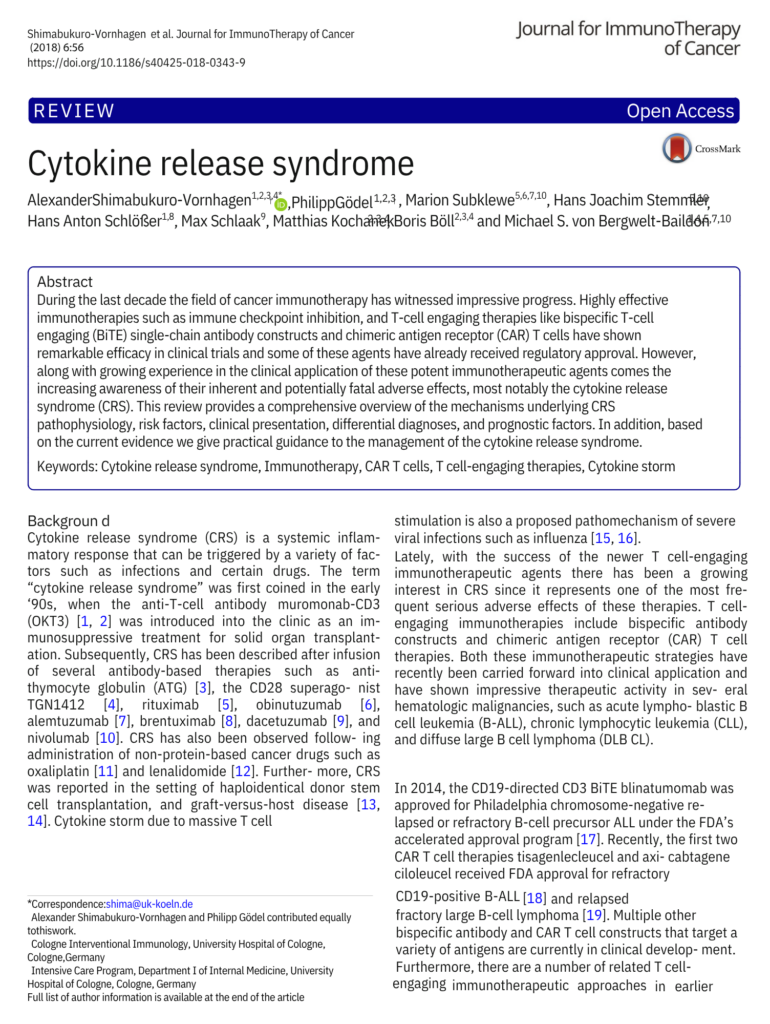
Attention to the review extended far beyond specialist oncology. It sits in the top 5% of all research outputs and has been referenced in 95 patents, showing its influence across clinical practice, research, policy, and therapeutic development.
As CAR T cell therapy and related treatments expand into new cancers and healthcare settings, clinicians continue to rely on guidance that helps them anticipate and manage CRS safely. By clarifying one of immunotherapy’s most serious complications at a formative moment in the field’s development, this review helped make the safe expansion of modern cancer immunotherapy possible.

Real voices, real change

Turning female elite athletes’ experiences into fairer sporting policies

Research from East Africa helps shape the future of global HIV care

Stroke studies from China shape global guidance

The diet that rewrote the rules on type 2 diabetes remission

Setting the international standard for lupus remission

Shaping national dietary guidance to prevent hypertension in Japan

Helping clinicians manage one of immunotherapy’s most serious risks

Beyond survival: Shaping the first roadmap for post-Covid rehabilitation

How Ugandan research shaped covid-19 treatment

From systematic reviews to global guidance

Championing the rights and health of street and working children

How evidence based policy can drive meaningful change

‘Renaissance era’ diagnosis of scurvy in today’s bariatric population

Raising awareness of a rare but serious risk linked to menstrual cup use

Stimulating international research dialogue on SGLT2 inhibitors and immune risk

Innovative device tackles racial bias in health monitoring, ensuring accurate readings for all skin tones

Revealing the hidden risks of slush ice drinks in children