
The diet that rewrote the rules on type 2 diabetes remission
An eight-year general practice audit of a low-carbohydrate approach became BMJ Nutrition, Prevention & Health’s most popular paper, reached the UK Parliament, and is reshaping how GPs talk about diabetes
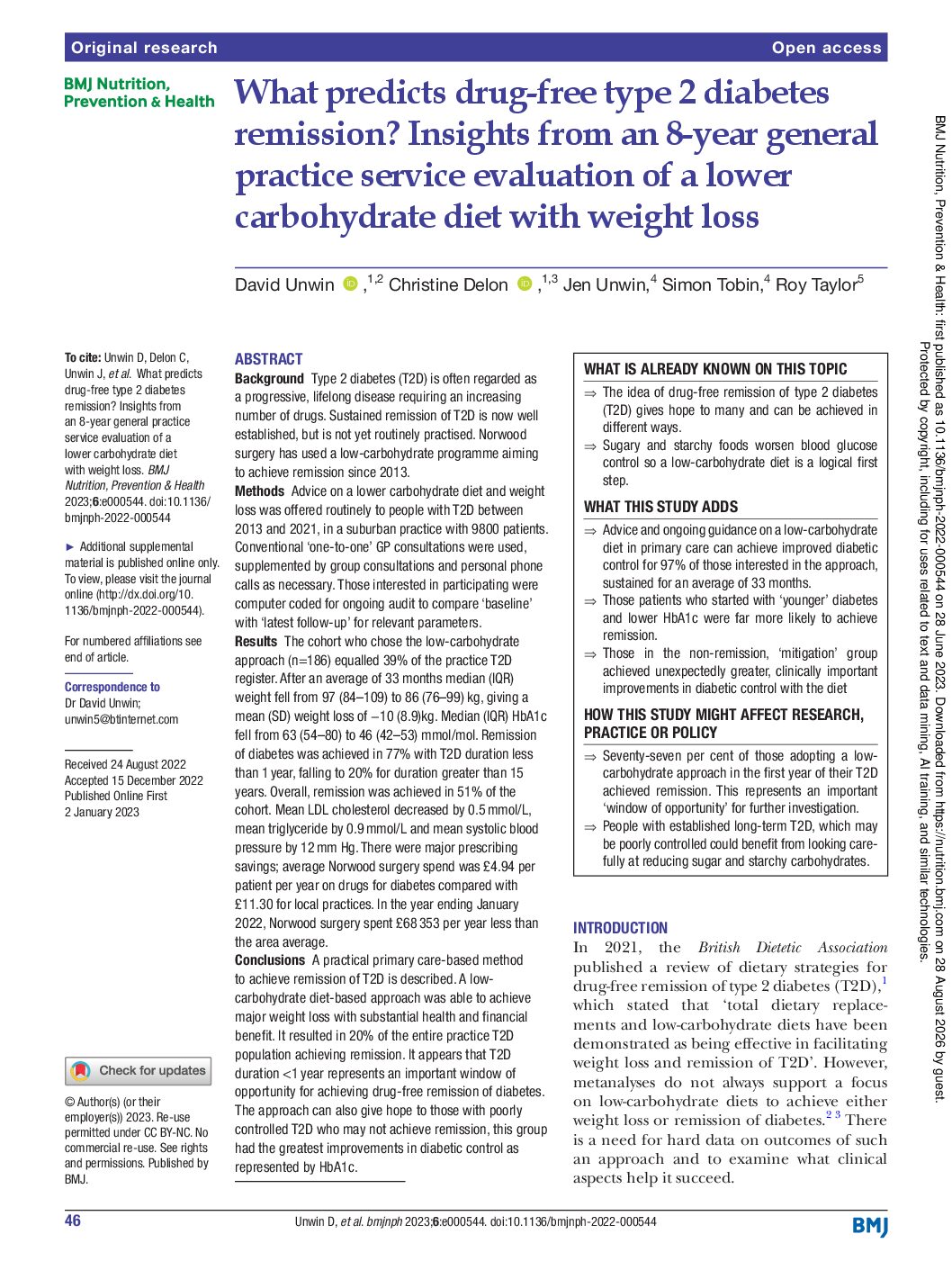
Clinicians have long treated type 2 diabetes as a progressive, drug-dependent disease. Published as “What predicts drug-free type 2 diabetes remission? Insights from an 8-year general practice service evaluation of a lower carbohydrate diet with weight loss,” the eight-year evaluation found that some patients could achieve drug-free remission. The article became the most discussed paper ever published in BMJ Nutrition, Prevention & Health.
For eight years, GPs and nurses at Norwood Surgery offered routine advice on a low-carbohydrate diet and weight loss to patients with type 2 diabetes, and tracked outcomes for 186 people against the practice’s wider list of 9,800 patients.
Among those who took up the approach, 51% achieved drug-free remission, rising to 77% among people diagnosed within the previous year. Average weight loss reached 10 kg, glycated haemoglobin (HbA1c) fell from 63 to 46 mmol/mol, and the surgery spent £68,353 less per year on diabetes drugs than the local average.
“Progress in medicine is made in partnership between clinicians and academics, we need both,” says lead author Dr David Unwin, a GP at Norwood Surgery and clinical adviser to the Royal College of General Practitioners (RCGP) on diabetes.

“Audits like ours provide the external validity to answer questions a randomised controlled trial can’t: how will this approach actually do in the NHS?”
Dr David Unwin, GP at Norwood Surgery; Clinical adviser to the Royal College of General Practitioners (RCGP)
The paper’s reach quickly outgrew the surgery. Written evidence submitted to the UK Parliament’s Health and Social Care Committee inquiry into prevention cited it directly, quoting the study’s remission rates, prescribing savings and average patient weight loss. It has since informed a Royal Australian College of General Practitioners clinical handbook on managing type 2 diabetes, and fed into a 2025 update of an RCGP e-learning module on diabetes and glycaemic index, now free to all 50,000 UK GPs.
“My practice has spent thirteen years trying to help people with type 2 diabetes who are interested in a drug-free approach to their condition,” Unwin says. “If we can use our data to interest our politicians as well as help patients, perhaps it was time well spent.”
Coverage spread fast, featuring on the BBC, Channel 4, Channel 5, and ITV News, and in New Scientist, The Times, Daily Mail, and The Express. ITV News gave the story a six-minute slot on its main bulletin, following patients including actor Sally Bankes as she came off long-term medication. The paper’s Altmetric Attention Score, a measure of the online conversation a paper generates, climbed past 3,000, against an average of c.100, for articles published in the same journal.
“I was astonished and delighted when we got to over 3,000,” Unwin says. “The public and the media seemed genuinely interested in the hope that drug-free remission brings to a condition previously considered chronic and deteriorating.”
Impact at a glance *
The practice’s “teaspoons of sugar” infographics, which show the sugar-equivalent of common foods, have been downloaded millions of times and translated into 39 languages by volunteers. In New Zealand, the data helped secure a government grant of around £1.5 million to trial the approach with Māori communities, and early results are already published. Other UK practices have replicated the findings, and one has since built a free app, Freshwell, based on the method.
Remarkably, no patient in eight years chose to stay on lifelong medication once offered the alternative of renewed dietary effort. As NHS England’s diabetes remission programme takes shape, Norwood Surgery’s data show how practice based evidence can complement randomised trials by demonstrating how an approach performs in routine NHS care.
Read more stories like this in our impact report
In our annual impact reports, we highlight our progress in research, education, publishing, and policy, and the ripple effect that better knowledge creates for patients and health systems worldwide.
Our vision is a healthier world where knowledge transforms care. As a global healthcare knowledge provider and wholly owned subsidiary of the British Medical Association (BMA), we remain focused on empowering health communities to not just survive, but thrive.
Real voices, real change

Turning female elite athletes’ experiences into fairer sporting policies
Research from East Africa helps shape the future of global HIV care

Stroke studies from China shape global guidance
The diet that rewrote the rules on type 2 diabetes remission
Setting the international standard for lupus remission

Shaping national dietary guidance to prevent hypertension in Japan
Helping clinicians manage one of immunotherapy’s most serious risks
Beyond survival: Shaping the first roadmap for post-Covid rehabilitation

How Ugandan research shaped covid-19 treatment

From systematic reviews to global guidance
Championing the rights and health of street and working children

How evidence based policy can drive meaningful change

‘Renaissance era’ diagnosis of scurvy in today’s bariatric population

Raising awareness of a rare but serious risk linked to menstrual cup use

Stimulating international research dialogue on SGLT2 inhibitors and immune risk
Innovative device tackles racial bias in health monitoring, ensuring accurate readings for all skin tones
Revealing the hidden risks of slush ice drinks in children