
From co-design to clinical practice: how Lewisham’s NHS lifestyle medicine service is improving health outcomes for people with long-term conditions
A community-designed lifestyle medicine service in south London is helping people with long-term conditions improve their health and wellbeing, while offering lessons for integrating personalised care into NHS primary care.
The Lifestyle Medicine Service was developed in Lewisham, south London, by general practitioner Dr Camille Hirons, working with local residents, patients and healthcare colleagues. It provides 12 weeks of personalised support from health and wellbeing coaches. The programme draws on the six pillars of lifestyle medicine: healthy eating, physical activity, restorative sleep, mental wellbeing and stress management, social connection, and reducing risky behaviours.
The service was initially developed in North Lewisham, where many residents experience health inequalities and face barriers to accessing healthcare. With 67% of the local population identified as belonging to CORE20PLUS groups, the programme set out to make personalised lifestyle support more accessible, particularly for people living with multiple cardiovascular risk factors and long-term conditions.
Since its introduction in April 2023, the service has expanded from North Lewisham to all seven of the borough’s primary care networks, becoming part of Lewisham’s integrated neighbourhood teams.
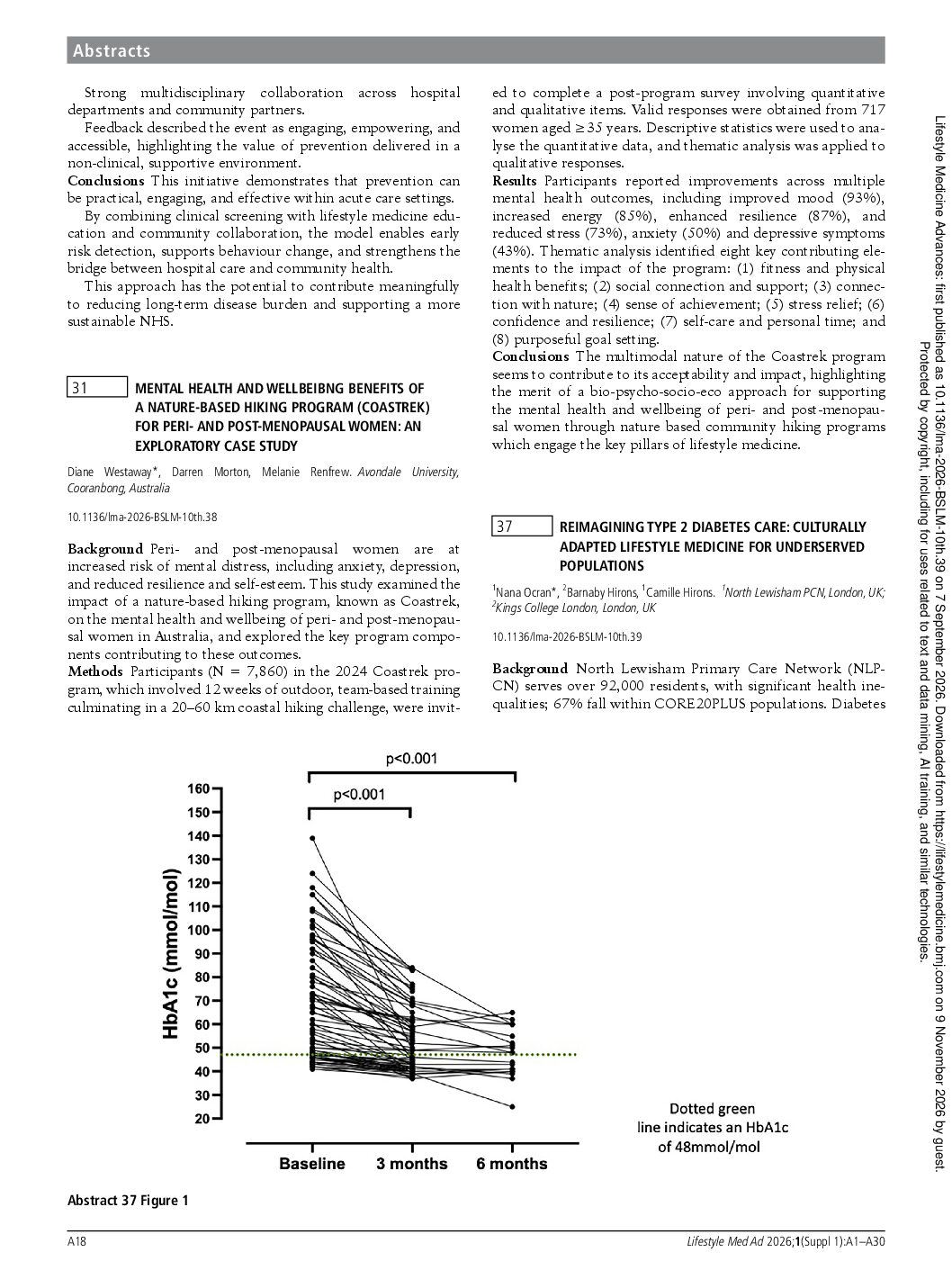
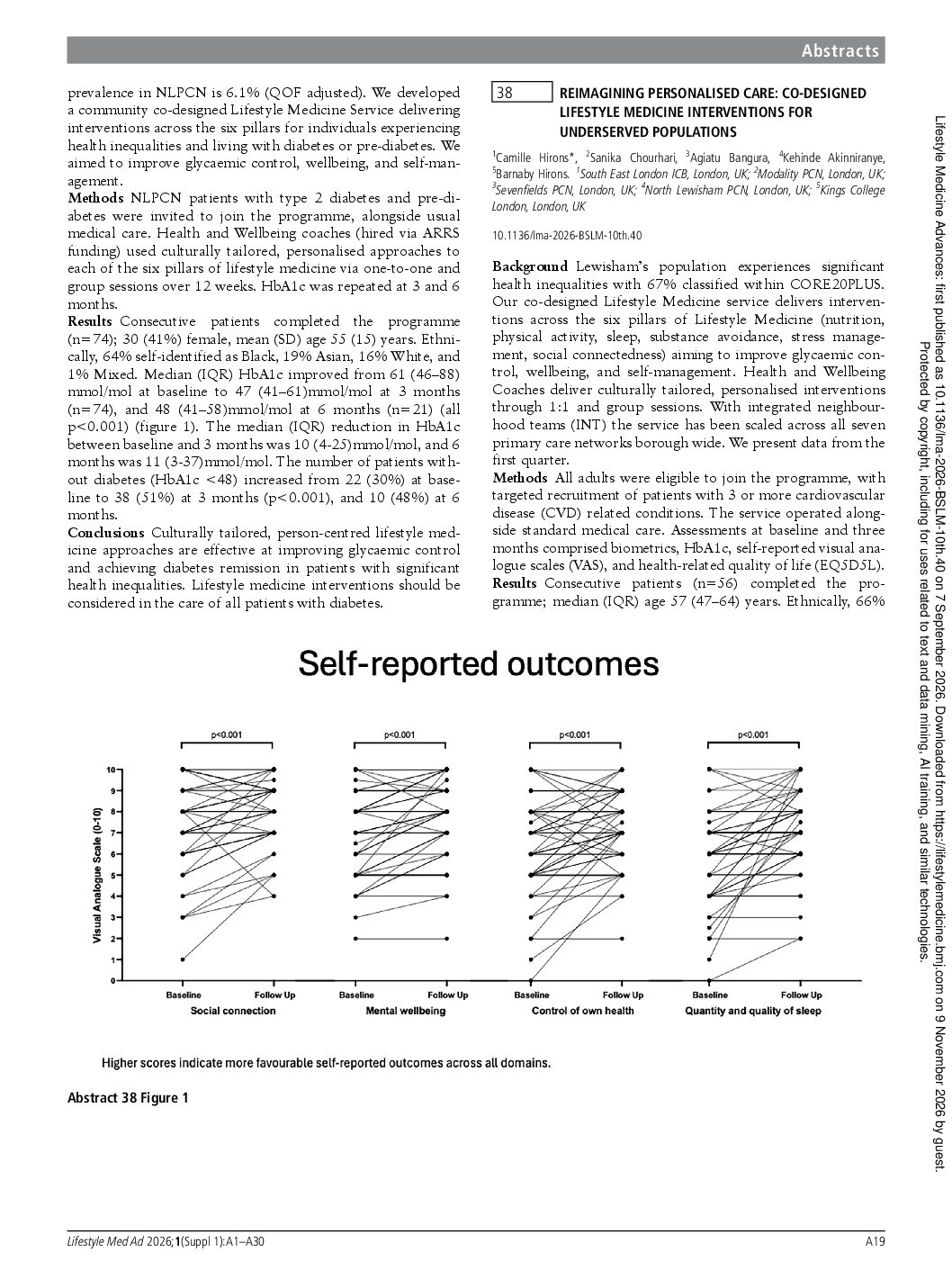
Early findings published in Lifestyle Medicine Advances, a journal from BMJ Group and the British Society of Lifestyle Medicine, reported improvements in blood glucose, blood pressure, and patient-reported wellbeing among 56 participants.

“Coaches meet people where they are, focus on what matters most to them and can connect them with other support.”
Camille Hirons, GP and vice-president of the British Society of Lifestyle Medicine
Speaking at NLMC 2026 – the Nutrition and Lifestyle Medicine Conference organised by Plant-Based Health Professionals UK, Hirons presented findings from a wider evaluation of the service, including improvements among people living with diabetes, prediabetes and hypertension.*
- Type 2 diabetes: 24% of 93 participants reached the non-diabetic HbA1c range.
- Prediabetes: 17% of 47 participants reached the normal glycaemic range.
- Hypertension: 57% of 30 participants had systolic blood pressure in the normal range.
- Participants also reported improvements in health, physical activity and daily plant intake.
Q&A with Dr Camille Hirons
In this Q&A with BMJ Group,* Hirons discusses what the team has learned from developing and expanding the service, the changes patients are experiencing, and why sharing practical evidence matters for NHS care.
What prompted you to develop the service?
“I wanted to bring lifestyle medicine into North Lewisham, where health outcomes were poor. We worked with local residents, patients, community organisations and healthcare staff to design the service together. Their response made it clear this wasn’t just something I wanted; it was something local people wanted too. They asked for a service that was welcoming, non-judgmental and open to everyone.”

What has shown you that the service is making a difference?
“The positive response from patients and community members involved in designing the service gave us confidence that it was something people wanted. Since then, patient feedback has shown us changes that are not always visible in the data. One person who had been reluctant to leave home gradually became more comfortable engaging with their coach and with everyday life. Those changes matter, even when they are harder to measure.”
What has changed as the service has expanded?
“Previously, access was limited to people registered with a small number of practices in north Lewisham. Now adults across the borough can access the service, and the team is part of the wider neighbourhood health offer. Demand has grown, and we’re exploring how to extend the approach into other community settings and support people living with cancer.”
What do the results mean for patients?
“The clinical results matter, but the experience of one patient shows what they can mean in someone’s life. One of our patients was a 72-year-old asylum seeker living with type 2 diabetes, hearing difficulties and unstable housing.
Finding somewhere secure to live was understandably his main concern. Health coach Nana Ocran worked closely with him, supported by an interpreter and his wife, to introduce practical lifestyle changes. These included using a pictorial food diary, a glucose sensor, culturally relevant dietary advice, and walking for 10 minutes after each meal.
His HbA1c fell from 95 to 59 mmol/mol. His wife’s HbA1c also fell, from 44 to 40 mmol/mol, as the household made dietary changes together. This unexpected ripple effect shows how personalised support can help patients take greater ownership of their health, with benefits extending to their families.”
How does the service support people facing other pressures, such as housing insecurity or language barriers?
“We need to challenge the assumption that someone dealing with housing or other social pressures won’t be interested in lifestyle support. We offer the option and let the person decide. Coaches meet people where they are, focus on what matters most to them and can connect them with other support. We don’t expect lifestyle medicine to solve every problem.”
Why did you publish the work as an abstract in Lifestyle Medicine Advances?
“People often asked whether we had published the findings. The abstract gave us a way to share what we were learning, and it gave the coaches who deliver the service the opportunity to present and take ownership of the work.
I’m not an academic or researcher, and I had some doubts about writing it up. Frontline teams may need practical support and confidence to turn their service experience into an abstract, evaluation or paper. It would be valuable for journals to help share strong examples and ensure the people doing the work have a voice.”
Reimagining personalised care: co-designed lifestyle medicine interventions for underserved populations
Lifestyle Medicine Advances
About Dr Camille Hirons
Dr Camille Hirons is a GP and vice-president of the British Society of Lifestyle Medicine. She helped lead the development of Lewisham’s co-designed service with local residents, patients, community organisations, and healthcare colleagues. Hirons is passionate about embedding lifestyle medicine practices within the NHS and using it to reduce health inequalities. Find out more: https://www.lifestylemedicineaccelerator.co.uk/team
Lifestyle Medicine Advances is open for submissions
We accept submissions of a wide range of article types, including original research, reviews and quality improvement pieces.
The Author Information section provides specific article requirements to help you turn your research into an article suitable for Lifestyle Medicine Advances. Information is also provided on editorial policies and open access.
Real voices, real change

Turning female elite athletes’ experiences into fairer sporting policies

Research from East Africa helps shape the future of global HIV care

Stroke studies from China shape global guidance

The diet that rewrote the rules on type 2 diabetes remission

Setting the international standard for lupus remission

Shaping national dietary guidance to prevent hypertension in Japan
Helping clinicians manage one of immunotherapy’s most serious risks
Beyond survival: Shaping the first roadmap for post-Covid rehabilitation

How Ugandan research shaped covid-19 treatment

From systematic reviews to global guidance
Championing the rights and health of street and working children

How evidence based policy can drive meaningful change

‘Renaissance era’ diagnosis of scurvy in today’s bariatric population

Raising awareness of a rare but serious risk linked to menstrual cup use

Stimulating international research dialogue on SGLT2 inhibitors and immune risk
Innovative device tackles racial bias in health monitoring, ensuring accurate readings for all skin tones

Revealing the hidden risks of slush ice drinks in children